


by Simon Crawford Welch, Ph.D.
The Coming Sea of Sameness
For decades, businesses invested enormous amounts of time, money, and effort trying to create competitive advantages. They hired talented copywriters, designers, marketers, strategists, and technologists. They built proprietary systems, developed unique processes, and sought every possible edge that would allow them to stand apart from their competitors. Success often belonged to those who could execute better, communicate more effectively, and innovate faster than everyone else.
Today, however, we find ourselves entering a fundamentally different landscape. Artificial intelligence has democratized capabilities that were once scarce and expensive. A small business owner now has access to writing tools that rival professional copywriters. A startup can generate sophisticated designs without employing a creative team. Marketing campaigns that once required agencies, specialists, and significant budgets can be developed in hours rather than weeks. Research that previously demanded days of effort can be completed in minutes.
This is, without question, a remarkable achievement. Yet it is also creating an unintended consequence. As organizations increasingly rely on the same AI tools, trained on similar datasets and guided by similar prompts, they are beginning to produce remarkably similar outputs. The language sounds familiar. The designs feel familiar. The ideas often feel familiar. What was intended to increase creativity may, paradoxically, be creating a world of increasing conformity.
The result is not bad content. In fact, much of it is quite good. The problem is that good is no longer enough. When everyone can produce competent work, competence ceases to be a differentiator. The question facing leaders today is therefore not whether they should embrace AI. They absolutely should. The more important question is how they maintain a sustainable competitive advantage when everyone has access to essentially the same tools.
The Commoditization of Competence
Historically, competence itself created meaningful separation. A company that wrote better marketing copy often attracted more customers. A business with superior design capabilities projected greater professionalism and trustworthiness. Organizations that could gather, analyze, and act upon information more effectively frequently outperformed their competitors.
Artificial intelligence is rapidly changing that equation. Many of the skills that once distinguished organizations are becoming widely available. Competent writing, competent design, competent research, competent coding, and competent marketing are increasingly accessible to anyone with an internet connection and a subscription fee.
This is not a criticism of AI. Quite the opposite. The technology is doing exactly what transformative technologies have always done: reducing barriers to entry and increasing productivity. The challenge is that when everyone gains access to the same capabilities, those capabilities no longer create meaningful differentiation.
We are already beginning to see evidence of this phenomenon. Browse LinkedIn and much of the content feels interchangeable. Visit company websites and many of them follow remarkably similar structures. Marketing campaigns increasingly rely on the same psychological triggers, storytelling frameworks, and optimization techniques. Thought leadership often consists of AI-generated summaries of ideas that have themselves been summarized countless times before.
The gap between poor and good execution is shrinking. The gap between good and genuinely distinctive execution, however, may be growing wider than ever.
Why Competitive Advantages Keep Disappearing
The history of business is filled with examples of competitive advantages that eventually vanished. Manufacturing advantages disappear as competitors adopt similar technologies. Distribution advantages erode as supply chains become more efficient. Information advantages fade as knowledge becomes more accessible. Even technological advantages often prove temporary as competitors reverse-engineer and replicate successful innovations.
The reality is that most advantages are eventually copied.
What has changed is the speed at which this occurs. In previous decades, competitors might have required years to imitate a successful strategy or product. Today, AI is dramatically compressing those timelines. A compelling marketing campaign can be analyzed and replicated almost immediately. A successful website can inspire dozens of near-identical versions within weeks. New ideas spread globally at unprecedented speed.
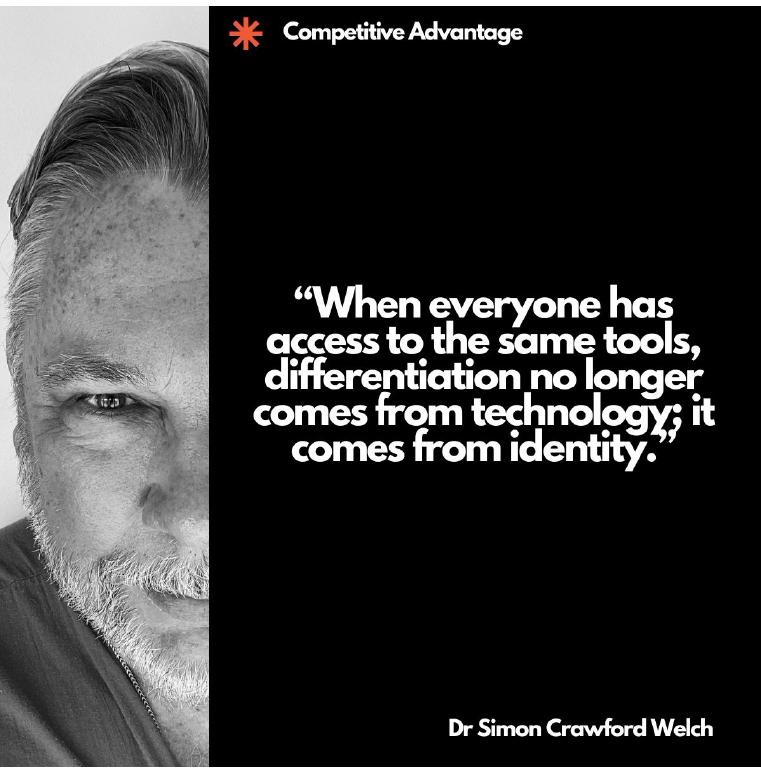
As a result, organizations can no longer rely solely on what they do. What they do can almost always be copied eventually. Increasingly, sustainable advantage comes from who they are, what they believe, and how they consistently show up in the marketplace.
This represents a profound shift in strategic thinking. The future belongs less to companies that simply possess capabilities and more to companies that possess identities.
The Rise of Authentic Scarcity
Economics teaches us that value is often driven by scarcity. When something becomes abundant, its value tends to decline. At the same time, other things become relatively more valuable because they remain difficult to obtain.
For much of human history, information was scarce. Knowledge was scarce. Expertise was scarce. Today, all three are becoming increasingly abundant.
As AI continues to flood the world with content, information, and ideas, a different set of assets is becoming scarce. Authenticity is becoming scarce. Trust is becoming scarce. Judgment is becoming scarce. Genuine human connection is becoming scarce.
These qualities are extraordinarily difficult to automate because they emerge from lived experience rather than data alone. An AI system can synthesize thousands of articles about leadership. It cannot spend twenty years leading people through uncertainty, conflict, and change. It can explain trust. It cannot earn trust. It can summarize customer service principles. It cannot build a reputation for consistently delivering on promises over decades.
This is why the future may belong to organizations that understand the difference between information and meaning. Information is increasingly abundant. Meaning remains scarce.
The more synthetic the world becomes, the more valuable authenticity becomes.
Why Experience Becomes the New Competitive Advantage
One of the most significant shifts of the AI era may be a renewed appreciation for experience. For years, businesses competed largely on access to knowledge. Today, knowledge is available almost instantly. What remains difficult to replicate is the wisdom that comes from lived experience.
There is a profound difference between knowing and understanding. AI can tell you how organizations navigate recessions. It cannot experience the pressure of making payroll during one. It can explain the principles of crisis management. It cannot feel the weight of making difficult decisions when the future is uncertain.
This distinction matters because leadership, strategy, and innovation rarely emerge from information alone. They emerge from judgment. They emerge from pattern recognition developed over years of successes, failures, mistakes, and lessons learned.
The leaders and organizations that thrive in the coming decade will not necessarily be those with the most information. They will be those with the best judgment. They will know when to trust the data and when to challenge it. They will know when to follow established practices and when to break the rules.
Experience is becoming valuable precisely because it cannot be downloaded.
Culture: The Advantage Competitors Cannot Easily Copy
Perhaps the most overlooked source of sustainable competitive advantage is organizational culture. While competitors can replicate products, pricing strategies, technologies, and marketing campaigns, culture remains remarkably difficult to duplicate.
Culture is not a mission statement hanging on a wall. It is the collection of behaviors, decisions, beliefs, and norms that shape how people interact with one another and with customers. It influences how quickly problems are solved, how conflicts are addressed, and how decisions are made.
Strong cultures create consistent experiences. Those experiences create emotional connections. Emotional connections create loyalty.
In an AI-driven world, this becomes increasingly important. As products become more similar and information becomes more accessible, customers often make decisions based on how a company makes them feel. They remember experiences more than features. They remember relationships more than specifications.
The irony is that many organizations continue searching for technological advantages while overlooking the human systems operating inside their own businesses. Yet culture may be the most durable competitive moat available because it cannot simply be copied through a prompt.
The Return of Conviction
Another consequence of widespread AI adoption is the tendency toward consensus. Most AI systems are optimized to provide balanced, reasonable, and broadly acceptable answers. While this is often useful, it rarely creates distinction.
The organizations that stand out in the future will likely be those willing to have a point of view. They will possess conviction. They will stand for something. They will challenge assumptions rather than merely repeat conventional wisdom.
Throughout history, memorable brands have rarely been built on neutrality. They have been built on clear beliefs and distinctive identities. People gravitate toward organizations that know who they are and communicate that identity consistently.
As more content becomes algorithmically optimized, originality may become one of the most valuable assets an organization can possess. Not originality for its own sake, but originality grounded in genuine belief and authentic experience.
In a world increasingly characterized by sameness, courage becomes a differentiator.
The Future Belongs to the Most Human Companies
The AI revolution is often described as a technological transformation. While that is certainly true, I suspect history may ultimately view it through a different lens. It may be remembered as the moment when humanity itself became a competitive advantage.
As machines become increasingly capable of generating content, creating designs, analyzing information, and automating routine tasks, the qualities that distinguish organizations become more profoundly human. Trust. Character. Purpose. Relationships. Judgment. Authenticity. Culture.
These are not remnants of a pre-digital world. They are emerging as the defining assets of the next one.
The winners of the coming decade will undoubtedly embrace artificial intelligence. To ignore these tools would be shortsighted. However, they will use AI as an amplifier rather than a substitute. They will leverage technology to improve efficiency, accelerate learning, and eliminate routine work. At the same time, they will invest relentlessly in the qualities that make them uniquely human.
Because in a world where everyone can create content, the true opportunity is not to create more noise. It is to create meaning.
And meaning remains one thing that no algorithm can manufacture.
Simon Crawford-Welch, PhD, is the Founder of The Scale Up Company (www.thescaleupcompany.com), which helps businesses turn ambition into disciplined, scalable execution so growth stops being chaotic and starts becoming intentional. His latest book, ‘Artificial Authority: When Leadership Is Performed Instead of Carried’, is available on Amazon. (https://a.co/d/082sCqm4)