


Why Emotional Intelligence Will Separate Leaders From Algorithms
By Simon Crawford Welch, PhD.
Artificial intelligence has changed the conversation about leadership, but perhaps not in the way most people think.
Much of the public debate has focused on what AI will replace. Will it replace programmers? Lawyers? Marketers? Consultants? Entire departments? Those are important questions, but they are not the most interesting ones. The more profound question is this: if machines become increasingly capable of performing the intellectual aspects of leadership, what remains uniquely human?
For decades, organizations rewarded executives largely for their ability to know more than everyone else. They accumulated information, developed expertise, solved complex problems, and made decisions that others could not. Intelligence became the currency of influence. The smartest person in the room often became the leader because knowledge itself was scarce.
That world is disappearing faster than most executives realize.
Today, anyone with access to an AI platform can produce remarkably sophisticated strategic plans, write compelling speeches, summarize financial reports, analyze market trends, draft board presentations, or generate thoughtful responses to almost any business problem. The quality of the output continues to improve at a breathtaking pace. What once required years of education or decades of experience can now be accomplished in minutes.
This is not diminishing the importance of intelligence. It is changing its value. When something becomes widely available, it becomes less differentiating. Throughout history, every technological revolution has shifted society’s definition of value. The Industrial Revolution reduced the premium placed on physical labor. The Information Age rewarded knowledge workers because information itself became valuable. Artificial intelligence is beginning to commoditize knowledge itself.
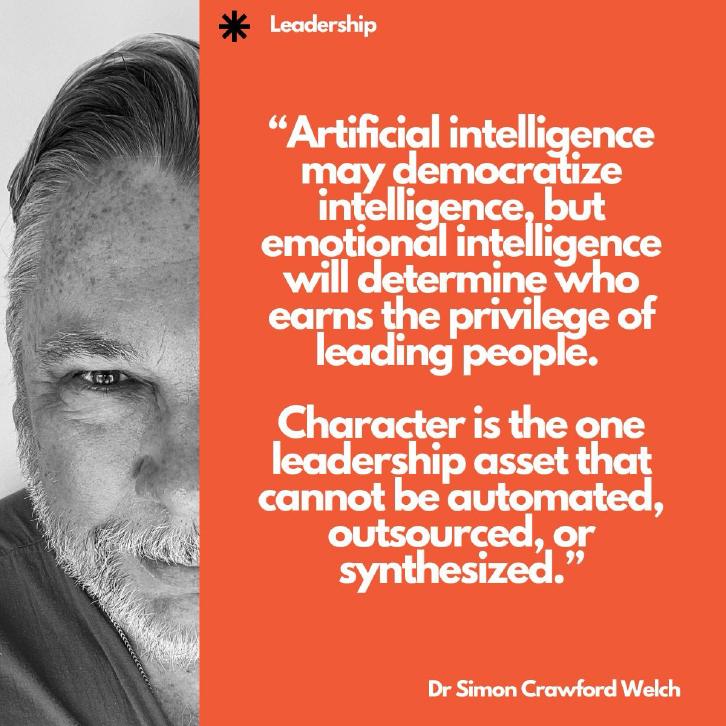
Ironically, the rise of AI may elevate something that organizations have often treated as secondary. Emotional intelligence, once dismissed by some executives as little more than a “soft skill,” is becoming one of the hardest competitive advantages to replicate. In a world where machines can think, calculate, write, and analyze with extraordinary speed, the ability to genuinely understand, inspire, and connect with other human beings becomes exponentially more valuable.
Intelligence Gets You in the Room; Character Determines Whether People Stay
Many leadership careers have been built on intellectual capability. High performers solve problems. They make difficult decisions. They demonstrate competence. Over time, competence earns promotions, larger teams, and greater responsibility. Yet almost every experienced executive has witnessed remarkably intelligent leaders fail, not because they lacked analytical ability, but because they lacked self awareness, humility, empathy, or integrity.
The reason is simple. Organizations are not mathematical equations. They are collections of human beings. Human beings are driven by trust, emotion, relationships, purpose, and meaning as much as they are by logic. A leader may have the perfect strategy, but if people do not believe in the person delivering it, execution inevitably suffers.
Research has reinforced this reality for years. Daniel Goleman’s work on emotional intelligence fundamentally changed how many organizations viewed executive effectiveness, arguing that emotional intelligence often distinguishes exceptional leaders from merely competent managers. More recently, studies from organizations such as McKinsey and Deloitte have consistently shown that employee engagement, psychological safety, and trust correlate strongly with organizational performance. Those outcomes are not created by spreadsheets or strategic frameworks alone. They emerge from leadership behaviors that make people feel respected, heard, and valued.
Artificial intelligence may make executives smarter. It cannot make them more trustworthy.
The Difference Between Performing Leadership and Carrying Leadership
One of AI’s greatest strengths may also become one of its greatest dangers.
Artificial intelligence is astonishingly good at creating polished communication. It can write inspirational speeches, compassionate emails, vision statements, performance reviews, and cultural manifestos that sound remarkably authentic. Increasingly, executives will be tempted to delegate not only administrative work to AI, but also much of their communication.
There is nothing inherently wrong with using AI as a thinking partner or writing assistant. Most leaders should. Productivity matters. Clarity matters. Good communication matters.
The danger begins when leaders confuse polished communication with authentic leadership.
Employees have always possessed an extraordinary ability to detect authenticity, even when they cannot articulate precisely why something feels genuine or artificial. They notice whether difficult conversations happen face to face or through carefully crafted emails. They notice whether apologies are accompanied by accountability. They notice whether values are demonstrated consistently or simply printed on conference room walls.
Leadership has never been defined primarily by eloquence. History is filled with leaders who were awkward speakers, imperfect communicators, or uncomfortable in front of large audiences. What made them influential was not their presentation skills. It was the congruence between what they believed, what they said, and how they behaved.
That congruence cannot be outsourced.
Real leadership is not something you perform. It is something you carry. It accompanies you into every meeting, every difficult conversation, every hiring decision, every ethical dilemma, and every moment when no one is watching. AI can help refine your words. It cannot manufacture your character.
Machines Can Simulate Empathy, But They Cannot Experience It
Perhaps the greatest misunderstanding surrounding artificial intelligence is the belief that if something appears empathetic, it effectively is empathetic.
Modern language models are becoming extraordinarily good at recognizing emotional patterns. They know what compassion sounds like. They understand how supportive language is structured. They can produce responses that comfort, encourage, and reassure. In many situations, those capabilities will create tremendous value.
Yet there remains a profound difference between recognizing emotion and experiencing it.
When an employee loses a spouse, receives a devastating medical diagnosis, or struggles with overwhelming anxiety, they are not looking for perfectly optimized language. They are looking for another human being who can sit with discomfort, share in uncertainty, and demonstrate genuine compassion. Presence cannot be automated. Neither can courage, humility, forgiveness, or sacrifice.
This distinction matters because leadership is fundamentally relational. Organizations do not function because information flows efficiently. They function because people choose to trust one another enough to work toward common goals. Trust is built through consistency, vulnerability, fairness, and shared experience. Those qualities emerge from character, not computation.
The Executive of the Future Will Need More Humanity, Not Less
There is a tendency whenever new technology emerges to assume that technical expertise will become the defining characteristic of future leaders. Certainly, executives who ignore AI will place themselves at a competitive disadvantage. Understanding how to leverage intelligent systems will become as fundamental as understanding spreadsheets or email became a generation ago.
However, mastering AI will simply become the price of admission. It will not be the source of lasting differentiation.
As artificial intelligence assumes more analytical work, executives will spend an increasing proportion of their time doing what machines cannot. They will coach struggling employees, resolve interpersonal conflict, navigate ethical ambiguity, build cultures of accountability, communicate through uncertainty, and make judgment calls where values matter more than data.
These responsibilities require emotional maturity more than technical brilliance. They require leaders who can regulate their own emotions before attempting to influence someone else’s. They require individuals comfortable admitting mistakes, changing their minds when presented with new evidence, and placing organizational purpose ahead of personal ego. Those capabilities have always mattered, but they will become even more valuable as AI continues reducing the scarcity of intellectual work.
The paradox is striking. The smarter our machines become, the more deeply human our leaders must become.
Leadership’s Next Great Test
Artificial intelligence is forcing executives to confront an uncomfortable reality. For many years, it was possible to mistake intelligence for leadership because possessing information created influence. That distinction is beginning to disappear. If everyone has access to exceptional analysis, beautifully written presentations, thoughtful recommendations, and sophisticated strategic insight, then intelligence alone can no longer explain why some leaders inspire extraordinary commitment while others struggle to earn basic trust.
The leaders who thrive during the next decade will not necessarily be those with the highest IQs or the greatest technical expertise. They will be the ones who consistently demonstrate integrity when shortcuts are available, empathy when pressure is highest, humility when success inflates ego, and courage when difficult decisions cannot be avoided. They will understand that while AI can dramatically improve how leaders think, only emotional intelligence determines how leaders make people feel.
Machines do not build loyalty. They do not inspire sacrifice. They do not earn trust during moments of uncertainty. They do not comfort frightened employees, resolve wounded relationships, or create cultures where people willingly give their very best. Those responsibilities remain profoundly human.
Perhaps that is the most encouraging lesson of the AI revolution. As technology becomes more intelligent, leadership itself becomes less about displaying brilliance and more about demonstrating humanity. The executives who recognize this shift early will not compete against artificial intelligence. They will use it to amplify their capabilities while investing even more deliberately in the qualities that technology can never replicate. In the end, history is unlikely to remember leaders because they wrote the best presentations or generated the most polished emails. It will remember them because people trusted them enough to follow.
Simon Crawford-Welch, PhD, is the Founder of The Scale Up Company (www.thescaleupcompany.com), which helps businesses turn ambition into disciplined, scalable execution so growth stops being chaotic and starts becoming intentional. His latest book, ‘Artificial Authority: When Leadership Is Performed Instead of Carried’, is available on Amazon. (https://a.co/d/082sCqm4)