


By Simon Crawford Welch, PhD
We are living through one of the most curious periods in the history of leadership. Never before have leaders had more opportunities to shape how they are perceived. Through social media, podcasts, personal branding, keynote speeches, company videos, and carefully curated online profiles, modern leaders can construct an image of themselves with remarkable precision. Visibility has become a leadership competency in its own right. The ability to command attention, cultivate a following, and project confidence is increasingly rewarded in boardrooms, businesses, politics, and public life.
Yet beneath this obsession with visibility lies a troubling question: what happens when image becomes more important than character?
The answer is uncomfortable because it strikes at the heart of many modern institutions. We increasingly live in a culture that rewards appearance over substance, perception over reality, and performance over authenticity. In such an environment, leaders often discover that it is easier to cultivate the appearance of integrity than to develop the real thing. It is easier to tell stories about values than to consistently live by them. It is easier to project confidence than to possess genuine wisdom.
The result is a growing disconnect between who leaders appear to be and who they actually are. That gap may be one of the defining leadership challenges of our time.
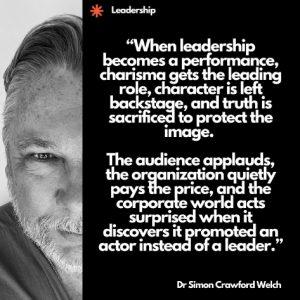
The Seduction of the Leadership Brand
The concept of personal branding has transformed leadership. On the surface, there is nothing inherently wrong with this. Effective communication matters. Visibility can create opportunities. A leader who can clearly articulate a vision often has a significant advantage over one who cannot.
The problem begins when the brand becomes more important than the person.
Many leaders spend enormous amounts of time managing their image. They carefully craft their public personas, polish their messaging, and refine their narratives. Every appearance becomes an exercise in impression management. Every public statement is scrutinized for its impact on perception. Over time, leadership can begin to resemble marketing more than stewardship.
This phenomenon is particularly evident in the corporate world. Executives are frequently encouraged to become public personalities. Investors want confidence. Employees want inspiration. Customers want purpose. The media wants compelling stories. The pressure to deliver these expectations creates an environment in which leaders can become trapped by the very image they have worked so hard to create.
The irony is that many organizations end up promoting those who are most skilled at appearing like leaders rather than those who possess the qualities that make leadership effective.
Why Character Matters More Than Ever
Character is an old-fashioned word that has largely disappeared from modern leadership discussions. We talk about engagement, innovation, emotional intelligence, strategic thinking, and culture. We talk about leadership styles, communication frameworks, and organizational design. Yet we rarely talk about character.
Perhaps that is because character is difficult to measure.
Character cannot be quantified on a dashboard. It does not appear in quarterly earnings reports. It cannot be summarized in a social media post. Character reveals itself slowly through decisions, actions, and patterns of behavior over time.
Most importantly, character reveals itself when circumstances become difficult.
Anyone can appear principled when doing so is easy. Anyone can speak about integrity when there is no cost attached. Character becomes visible only when values collide with incentives. It emerges when leaders must choose between what is right and what is expedient. It becomes apparent when no one is watching and when there is little external reward for doing the right thing.
This is why image and character are fundamentally different. Image is about what people think of you. Character is about who you are.
One can be manufactured. The other must be earned.
The Authenticity Illusion
Few concepts are discussed more frequently in modern leadership circles than authenticity. Leadership books praise it. Consultants encourage it. Organizations claim to value it. Yet genuine authenticity appears to be increasingly rare.
Part of the problem is that authenticity itself has become a performance.
Today’s leaders are often taught how to appear authentic. They are encouraged to share personal stories, reveal carefully selected vulnerabilities, and demonstrate relatability. These practices can be valuable when they emerge naturally. However, when authenticity becomes a strategy rather than a state of being, something important is lost.
A leader who reveals vulnerability because it is fashionable is not necessarily authentic. A leader who shares personal struggles because it enhances a personal brand is not necessarily authentic. A leader who adopts the language of humility while privately pursuing status and recognition is not necessarily authentic.
True authenticity is not about carefully managed openness. It is about alignment.
It is the alignment between public values and private behavior. It is the consistency between words and actions. It is the willingness to tell the truth even when the truth is uncomfortable, inconvenient, or unpopular.
Authenticity is not a communication technique. It is a character trait.
Unfortunately, many modern leadership development programs focus heavily on the former while neglecting the latter.
The Cost of Living Behind the Mask
There is another dimension to this issue that receives far less attention. The leadership mask does not only damage organizations. It often damages leaders themselves.
Maintaining an image requires constant effort. Leaders who become overly invested in perception find themselves living under immense psychological pressure. Every interaction becomes strategic. Every decision becomes filtered through concerns about reputation. Every public appearance becomes another opportunity to reinforce the narrative.
Over time, the distinction between the real person and the projected image can begin to blur.
Many leaders reach a point where they no longer know whether they are acting from conviction or simply protecting the identity they have created. They become prisoners of their own brand. The public version of themselves becomes more important than the private version.
This helps explain why so many highly successful leaders report feelings of isolation, burnout, and dissatisfaction despite achieving extraordinary levels of recognition. Success built on image often proves surprisingly hollow because it requires continuous maintenance. The applause never lasts. The validation is never permanent. The performance must continue.
The tragedy is that some leaders spend decades building reputations while neglecting the deeper work of building themselves.
The Erosion of Trust
Perhaps the most significant consequence of image-driven leadership is the gradual erosion of trust.
Trust is the foundation upon which all leadership rests. Without trust, authority becomes fragile. Influence becomes temporary. Culture becomes performative. Organizations become cynical.
Today, trust in leaders is declining across many sectors of society. Employees increasingly question corporate messaging. Citizens express growing skepticism toward political leaders. Consumers doubt the authenticity of corporate commitments and social initiatives.
While many factors contribute to this trend, one of the most important is the widening gap between rhetoric and reality.
People are remarkably perceptive when it comes to inconsistency. They may not immediately identify the source of their discomfort, but they recognize when something feels inauthentic. They notice when leaders preach accountability while avoiding responsibility. They notice when organizations promote values that are absent from everyday behavior. They notice when purpose statements become substitutes for principled action.
Trust rarely disappears overnight. It erodes gradually through countless small contradictions. Each compromise weakens credibility. Each inconsistency widens the gap between image and reality.
Eventually, the mask begins to crack.
A Return to Authentic Leadership
The future of leadership may depend less on visibility and more on authenticity. In a world saturated with carefully crafted images, genuine character becomes increasingly valuable. In an environment where perception can be manipulated, truth becomes a competitive advantage.
The leaders who will stand apart in the years ahead may not be the most charismatic, the most visible, or the most polished. They may be the individuals who possess the courage to be themselves. They may be the leaders who are willing to admit uncertainty, acknowledge mistakes, and tell uncomfortable truths. They may be the leaders who understand that credibility is earned through consistency rather than communication.
Character is not glamorous. It develops slowly and often invisibly. It is built through habits, choices, sacrifices, and principles repeated over time. Unlike image, it cannot be outsourced, delegated, or manufactured.
Yet character possesses something that image never will.,,,,, Durability.
Image can create admiration. Character creates trust…….Image can attract followers. Character inspires loyalty……Image can generate attention. Character leaves a legacy.
The great leadership challenge of our era is not learning how to be seen. It is learning how to be real. Because when the speeches are over, the cameras are gone, and the applause has faded, people ultimately remember far less about what leaders projected than about who they truly were.
And history, unlike social media, has a remarkable way of eventually revealing the difference.
Simon Crawford-Welch, PhD, is the Founder of The Scale Up Company (www.thescaleupcompany.com), which helps businesses turn ambition into disciplined, scalable execution so growth stops being chaotic and starts becoming intentional. His latest book, ‘Artificial Authority: When Leadership Is Performed Instead of Carried’, is available on Amazon. (https://a.co/d/082sCqm4)