


By: Simon Crawford Welch, PhD
There is a moment in almost every founder-led company when growth stops feeling like momentum and starts feeling like drag. What once felt fast begins to feel heavy, decisions slow down, teams hesitate, and while revenue may still be climbing, something underneath it all starts to tighten. This is the founder bottleneck, and the uncomfortable truth is that most companies do not hit a market ceiling, they hit a leadership ceiling.
Founders are often the reason a business works in the beginning. Their intensity creates speed, their instincts create traction, and their standards create differentiation. But the same traits, left unchecked, become constraints. What built the business becomes what breaks the business, because scaling is not about doing more of the same, it is about becoming different, and most founders wait too long to make that shift.
1. The Founder Stays at the Center of Every Decision. Centralization creates speed early, but it creates suffocation later. When every meaningful decision routes through the founder, the company begins to move at the speed of one person, and no matter how capable that person is, the business cannot outpace its own dependency. A company that queues behind its founder is not scaling, it is stalling.
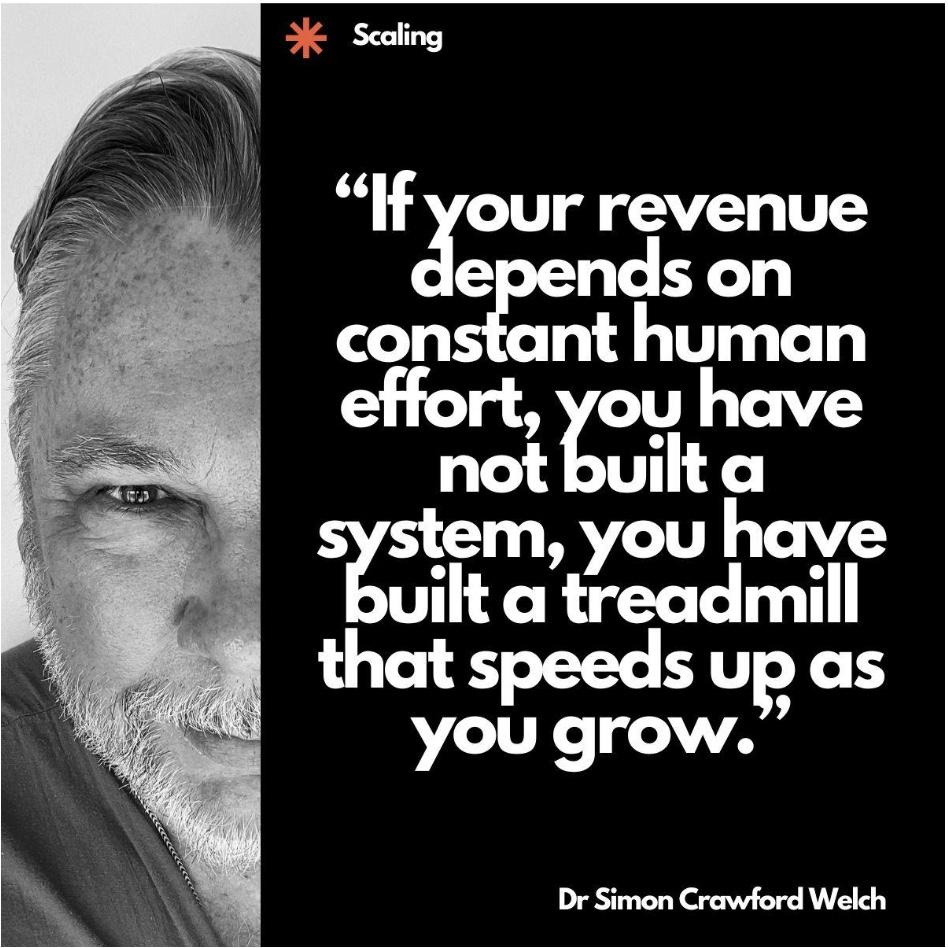
2. Lack of System-Driven Revenue. If revenue depends more on people than on systems, it will always be fragile. Human effort is inconsistent by nature, while systems create repeatability and predictability. When your pipeline has to be rebuilt every month through effort instead of flowing through structured demand generation, you are not scaling a business, you are rebuilding it over and over again.
3. Undefined Operating Systems. Growth without structure eventually turns into chaos with better marketing. Without clear operating rhythms, accountability frameworks, and defined performance metrics, teams default to activity rather than output. If your business only works when you are in the room directing it, then the business itself is not working, you are.
4. Hiring Ahead of Clarity. Hiring without defined ownership creates expensive confusion. Founders often bring in talented people to solve problems, but without clear roles, success metrics, and decision rights, those individuals cannot perform at a high level. Talent does not compensate for structural ambiguity, it is constrained by it.
5. Inability to Let Go of Control. Delegation is not about offloading tasks, it is about transferring decision authority. Founders who struggle to let go of control create organizations where people wait instead of act, and over time that hesitation compounds into lost speed and lost opportunity. If your team needs permission to move, then you have become the bottleneck, whether you intended to or not.
6. Overreliance on Heroics. Many early wins in a company come from heroic effort, late nights, last-minute saves, and constant problem-solving under pressure. While this can create short-term results, it prevents the development of repeatable systems. A business that relies on heroics is not scaling performance, it is normalizing instability.
7. Misaligned Incentives. People optimize for what they are rewarded for, not what leadership hopes they will prioritize. Founder-led companies often overlook the precision required in incentive design, which leads teams to focus on activity instead of outcomes. If incentives are misaligned, behavior will drift, and over time that drift becomes embedded in the culture.
8. Founder Identity Becomes the Brand. When the founder becomes inseparable from the brand, the business struggles to operate independently. Customers, partners, and employees begin to orient around the founder rather than the system, which creates a ceiling on growth. If the brand cannot stand without the founder’s constant presence, then the business cannot truly scale beyond them.
9. Lack of Financial Discipline. Revenue can create the illusion of progress, but margins reveal the truth. Many founder-led companies focus on top-line growth without developing a deep understanding of unit economics, contribution margins, and cost structure. As the business scales, these blind spots are not reduced, they are amplified.
10. Failure to Build Middle Leadership. A company cannot scale on the back of a founder and frontline employees alone. Without strong middle leadership to translate strategy into execution, there is a structural gap where ideas fail to become outcomes. Scaling requires layers of ownership, not a single point of control.
11. Everything Remains a Priority. Founders are often driven by opportunity, which leads to the constant addition of new initiatives. Without disciplined prioritization, teams become fragmented and execution quality declines. Every new initiative consumes attention, and attention is the most limited resource in any organization.
12. Poor Data Infrastructure. Intuition may be enough to get a business started, but it is not enough to scale it. Without clean data, proper attribution, and reliable reporting systems, decisions are made in partial blindness. If you do not know your numbers with precision, then your growth is based more on belief than on reality.
13. Inconsistent Customer Experience. As companies grow, maintaining a consistent customer experience becomes more difficult. Founder-led businesses often rely on informal standards that do not scale across teams and locations. When experience varies too widely, trust erodes, and brand equity weakens over time.
14. Resistance to Process. Many founders equate process with bureaucracy, but in reality, process is what allows excellence to repeat. Without defined workflows and standards, teams are forced to recreate solutions repeatedly, which reduces efficiency and increases error rates. Process is not the enemy of creativity, it is what makes it scalable.
15. Scaling Revenue Without Scaling Infrastructure. Growth in demand without corresponding investment in systems, people, and operations creates bottlenecks that eventually surface. Teams become overwhelmed, service quality declines, and the organization begins to strain under its own success. You do not rise to the level of demand, you fall to the level of your systems.
16. Emotional Decision-Making. Founders are deeply connected to their businesses, which can lead to decisions influenced by emotion rather than data. While passion is an asset in the early stages, inconsistency in decision-making becomes a liability at scale. When decisions fluctuate, the organization loses stability.
17. Lack of Clear Accountability. When ownership is unclear, performance suffers. Founder-led companies often operate in a state where multiple people are involved in a function, but no one is truly accountable for the outcome. Clarity in ownership is not about control, it is about ensuring that results are owned and delivered.
18. Failure to Evolve the Business Model. What works at one stage of growth rarely works at the next. Pricing strategy, positioning, and go-to-market approaches must evolve as the company scales. Founders who hold onto earlier models too long find themselves constrained by the very structures that once drove success.
19. Overdependence on Key Individuals. If the business cannot operate without certain individuals, then it is structurally fragile. Founder-led companies often build around people rather than systems, which creates risk as the organization grows. Sustainable scale requires that performance be embedded in the system, not isolated in individuals.
20. Inability to Transition from Builder to Leader. The most important shift is the transition from builder to leader. Builders create momentum through direct involvement, while leaders create systems that produce outcomes without constant intervention. If a founder continues to operate as a builder at scale, they inevitably become the constraint on the organization’s growth.
The Real Constraint
It is easy to believe that scaling challenges are external, whether they are market conditions, competition, or hiring difficulties. While these factors do play a role, they are rarely the primary constraint. The real constraint is internal, rooted in the founder’s behaviors, assumptions, and unwillingness to evolve alongside the business.
Scaling is not a tactic or a single strategic move, it is an identity shift. It requires moving from being the engine of the business to becoming the architect of the system. It requires designing structures that allow the organization to perform without constant intervention, and that shift is as personal as it is operational.
Founder-led companies do not fail to scale because they lack opportunity, they fail because they hold onto the very traits that made them successful in the first place. The bottleneck is rarely in the market or the model, it is in the founder’s ability to let go, to redesign, and to build something that no longer depends on them.
In the end, a business that cannot operate without the founder is not a scalable company, it is a job that has simply grown larger, more complex, and far more demanding than it was at the start.
Simon Crawford-Welch, PhD, is the Founder, The Critical Thought Lab. His latest book, “Artificial Authority: When Leadership is Performed Instead of Carried” was released in March 2026. He is also the author of “American Chasms: Essays on the Divided States of America” & “The Wisdom of Pooh: Timeless Insights for Success & Happiness” (Available on Amazon) www.linkedin.com/in/simoncrawfordwelch