

By Simon Crawford Welch, PhD
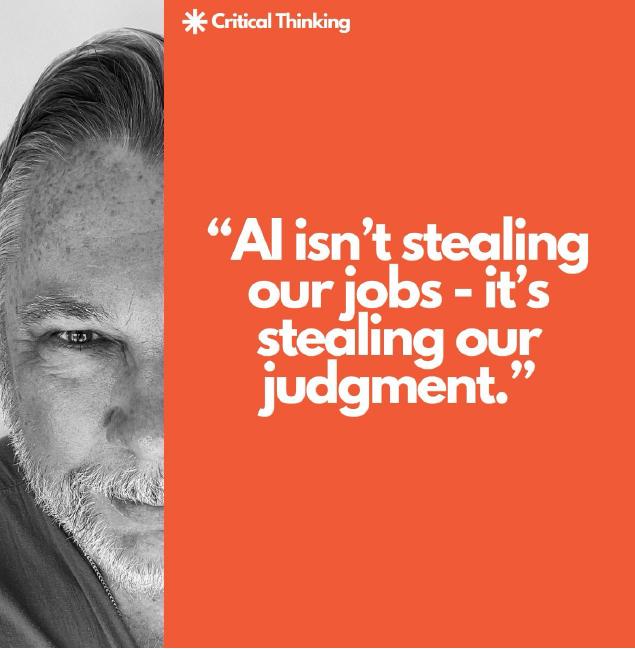 When was the last time you truly wrestled with a problem – alone? No Google search, no ChatGPT, no Reddit thread whispering suggestions? Be honest.
If you’re like most of us, probably not recently. And that’s not entirely your fault. The rise of generative AI tools – ChatGPT, Claude, Gemini, Midjourney – has given us the seductive convenience of instant answers. But here’s the paradox: the more we outsource our thinking, the less capable we become of doing it ourselves.
The New Cognitive Shortcut
AI has become our intellectual autopilot. We ask it to draft our emails, summarize books, even outline our strategies. According to a 2024 Pew Research study, 62% of U.S. professionals now use AI tools weekly for work-related tasks. That’s a staggering adoption rate for technology that didn’t even exist publicly three years ago.
But there’s a catch: convenience always comes at a cost. As psychologist Daniel Kahneman famously wrote in Thinking, Fast and Slow, “The ease with which an answer comes to mind is often a misleading cue for its validity.” AI tools amplify that trap. They give us fluent, confident, and often wrong answers – wrapped in eloquence that discourages scrutiny.
Research from the University of Pennsylvania (2023) found that participants who used AI writing tools were more likely to accept incorrect information if it was phrased confidently. The smoother the text, the more credible it felt. That’s not artificial intelligence – it’s artificial persuasion.
The Subtle Erosion of Autonomy
Autonomy isn’t just about doing things yourself—it’s about deciding for yourself. Yet AI systems quietly chip away at that independence by influencing our decisions before we even realize it.
Every autocomplete suggestion, every “recommended for you,” every algorithmic summary shapes our perception of what’s relevant, important, or true. Over time, we begin to mistake machine preferences for our own.
A 2023 MIT study found that people exposed to AI-generated suggestions in decision-making tasks were 23% less likely to revise or challenge the tool’s recommendations, even when shown evidence the model was biased. The researchers called it “automation persuasion” – a kind of cognitive inertia where we defer to the algorithm simply because it seems objective.
But let’s be clear: algorithms aren’t neutral. They’re human creations – trained on human data, built with human assumptions. Every model reflects the biases, omissions, and blind spots of its creators.
So when you let an AI write your strategy memo or summarize your data, you’re not getting a neutral view – you’re getting someone else’s worldview, distilled and digitized.
Why It Matters
Think about the muscle analogy: if you stop using your physical muscles, they atrophy. The same goes for your cognitive ones.
When AI performs the hard parts of thinking – structuring arguments, weighing tradeoffs, filtering data – we lose the micro-frictions that build intellectual resilience. Those frictions are where creativity lives. It’s in the messy middle between confusion and clarity that we form insights worth having.
Nick Carr warned of this over a decade ago in The Shallows: What the Internet Is Doing to Our Brains:
“What the Net seems to be doing is chipping away my capacity for concentration and contemplation.”
Now imagine that on steroids, powered by AI. The danger isn’t just distraction – it’s dependency.
If every idea begins with “Ask ChatGPT,” what happens to originality? If every argument is structured by an algorithm, what happens to critical thinking?
Harvard cognitive scientist Steven Pinker once said, “Cognitive effort is the price we pay for autonomy.” AI promises to make us smarter, but it might just be making us more passive.
The False Comfort of Certainty
AI’s biggest seduction is certainty. It speaks with confidence, never hesitating, never saying, “I’m not sure.” But real reasoning thrives in uncertainty.
In human conversation, doubt is a sign of depth. We pause, we reconsider, we ask, “What if I’m wrong?” Machines don’t do that – at least not yet. And when we start mirroring their confidence, we risk losing intellectual humility—the cornerstone of wisdom.
A 2024 Stanford survey found that over 70% of college students admitted using AI for writing assignments, but only 18% cross-checked its factual claims. The irony? The very generation raised on “check your sources” is now outsourcing truth itself.
What We Can Do About It
So how do we engage AI without losing ourselves?
The answer isn’t rejection – it’s reflection. AI is a tool, not a truth. The goal isn’t to avoid it, but to stay awake while using it.
Here are a few mental habits to protect your reasoning muscles:
- Pause before you prompt. Ask yourself: “Do I already have an idea here?” AI should expand your thinking, not replace it.
- Interrogate the output. Every time AI gives you an answer, ask: “Who made this?” “What data trained it?” “What’s missing?”
- Use it as a mirror, not a crutch. Let AI test your logic – but don’t let it form your logic.
- Preserve your struggle. That uncomfortable feeling of not knowing? It’s the birthplace of learning. Don’t rush to outsource it.
- Reclaim authorship. Rewrite AI drafts in your own words. Force your brain to re-engage with the content.
AI should be your collaborator, not your commander. As futurist Kevin Kelly put it,
“You’ll be paid in the future for how well you work with AI – not how often you obey it.”
The Future of Human Reasoning
The next decade will redefine what it means to think. Machines will generate ideas faster than we can process them. Knowledge will be abundant, but wisdom – wisdom will be rare.
Our challenge isn’t to outsmart AI – it’s to stay human amid the flood of synthetic intelligence. That means valuing curiosity over convenience, judgment over jargon, discernment over data.
Autonomy in the age of AI isn’t about rejecting help; it’s about remaining the final author of your choices.
So the next time an AI gives you a slick, convincing answer, take a breath. Then do what only humans can do – question it.
Because the future of thinking depends on whether we still know how.
Simon Crawford-Welch, PhD, is the Founder, The Critical Thought Lab. Author of “American Chasms: Essays on the Divided States of America” & “The Wisdom of Pooh: Timeless Insights for Success & Happiness” (Available on Amazon) www.linkedin.com/in/simoncrawfordwelch