


By Simon Crawford Welch, PhD
There is a growing risk in modern organizations that almost no one wants to talk about.
It’s not that artificial intelligence will become sentient. It’s not that machines will overthrow humanity. The real danger is far quieter and far more probable: leaders slowly surrendering their judgment to systems that were meant to assist them, not replace them.
AI doesn’t seize control. It gets handed control… incrementally, rationally, efficiently.
And in the process, leadership itself begins to erode.
The Seduction of Precision
Artificial intelligence is intoxicating because it offers precision in a world filled with ambiguity. It produces forecasts with decimal points, risk scores with confidence intervals, and dashboards that glow with real-time clarity. For executives under pressure, this feels like oxygen. Decisions that once required debate and discomfort can now be “data-driven.”
But leadership has never been about eliminating uncertainty. It has been about navigating it.
The moment a leader begins to treat probabilistic outputs as unquestionable authority, something shifts. The algorithm becomes the decision-maker. The leader becomes the implementer. Instead of wrestling with trade-offs, they point to a model and say, “The system recommends.”
That language sounds responsible. In reality, it often masks abdication.
Optimization Is Not Wisdom
AI is exceptional at optimization. It can maximize revenue, reduce churn, predict performance risk, and fine-tune pricing in ways no human analyst could match at scale. But optimization and wisdom are not the same thing.
A model might suggest eliminating a slower-performing team member who quietly anchors culture. It might recommend cutting an offering that produces modest margins but deep loyalty. It might optimize for short-term yield at the expense of long-term trust.
On paper, the move looks brilliant. In practice, it creates fragility.
Wisdom requires context, narrative memory, moral consideration, and an understanding of second- and third-order effects. AI has patterns. Leaders must have perspective. When leaders confuse efficiency with wisdom, they build organizations that are numerically strong and emotionally brittle.
The Illusion of Objectivity
Another danger is the illusion that AI is neutral. Data feels objective. Algorithms feel unbiased. Dashboards feel scientific. But AI systems are trained on historical data, and historical data reflects historical incentives, blind spots, and biases.
If past hiring rewarded conformity, the model will quietly replicate that pattern. If past sales tactics favored urgency over integrity, predictive systems will reinforce that strategy. AI doesn’t invent bias; it scales what already exists.
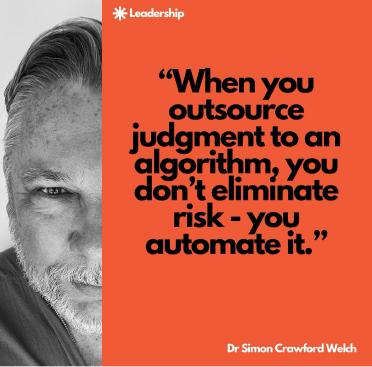
When leaders fail to interrogate outputs, they don’t eliminate bias – they automate it.
And when those biases create harm, it will not be the model answering for it. It will be the leadership team.
The Atrophy of Judgment
Perhaps the most insidious effect of overreliance on AI is cognitive atrophy. Judgment is a muscle. Moral reasoning is a muscle. Strategic discernment, built from years of lived experience, is a muscle.
Muscles weaken when they are not used.
If every difficult decision is deferred to a model, leaders slowly lose their tolerance for ambiguity. They become uncomfortable making calls without dashboards. They hesitate to override recommendations. They struggle to articulate convictions that are not backed by charts.
Over time, the vocabulary of leadership changes. “The system says” replaces “I believe.” “The dashboard indicates” replaces “Here’s the trade-off we are willing to make.”
When ownership disappears from language, accountability soon follows.
Culture Cannot Be Automated
AI can generate mission statements. It can draft performance reviews. It can simulate empathy in customer responses and optimize internal communications. But culture is not written, it is embodied.
Culture is shaped in hard conversations, in moments of conflict, in the way leaders respond when performance drops or trust fractures. It is forged in vulnerability, courage, and moral clarity.
No algorithm can sit across from a struggling team member and take responsibility. No system can absorb blame during a crisis. No machine can model integrity under pressure.
Leadership is relational. AI is transactional. Confusing the two leads to hollow organizations that look polished but feel empty.
When Metrics Become Morality
In AI-driven organizations, what can be measured often becomes what matters. Engagement scores, revenue per customer, response times, predictive retention metrics… all of these are valuable. But they are not the whole story.
Trust compounds invisibly. Psychological safety grows quietly. Creative risk-taking often looks inefficient in the short term. Not everything meaningful fits neatly into a KPI.
When leaders over-index on dashboards, they risk mistaking measurement for meaning. If numbers rise, they assume they are virtuous. If numbers fall, they assume someone is failing.
But leadership is not about chasing green metrics. It is about stewarding long-term value—financial, relational, and cultural.
Speed Without Reflection
AI accelerates decision cycles. Strategies that once required weeks of analysis can now be modeled in minutes. Marketing campaigns can be generated in seconds. Customer insights update in real time.
Speed feels like progress.
But leadership requires reflection.
Without deliberate pauses, acceleration becomes reaction. Organizations begin pivoting constantly, chasing micro-signals from models without grounding themselves in long-term identity. The faster the tools become, the more disciplined leaders must be about slowing down.
Otherwise, velocity replaces vision.
The Real Leadership Test
The central question of the AI era is not whether machines will become more intelligent. They will. The question is whether leaders will become more disciplined.
AI is leverage. And leverage magnifies character.
If a leader is short-term oriented, AI will amplify short-termism. If a leader lacks moral clarity, AI will scale ambiguity. If a leader avoids hard conversations, AI will provide endless data to hide behind.
The organizations that thrive will not be those that surrender to automation, nor those that resist it blindly. They will be led by individuals who use AI as a tool—never as a substitute for courage.
Because at the end of the day, no algorithm can carry moral responsibility.
That weight still belongs to the human in the chair.
Simon Crawford-Welch, PhD, is the Founder, The Critical Thought Lab. His latest book, “Artificial Authority: When Leadership is Performed Instead of Carried” is scheduled to be released in March 2026. He is also the author of “American Chasms: Essays on the Divided States of America” & “The Wisdom of Pooh: Timeless Insights for Success & Happiness” (Available on Amazon) www.linkedin.com/in/simoncrawfordwelch