


BySimon Crawford Welch, PhD
The Strange Decline in a Smart Age
We’re living in the most information-saturated era in human history, yet somehow thinking has become a lost art. It’s not just ignorance – it’s a growing pride in not knowing. We’re watching the rise of what can only be called collective stupidity: the cultural slide toward simplistic thinking, dismissing expertise, celebrating “gut instinct,” and clinging to beliefs even when facts scream otherwise. And while it feels sudden, this shift has been building for decades through political rhetoric, educational decay, and the chaos of digital media.
What Intellectualism Actually Is
Intellectualism isn’t about being a genius – it’s about curiosity, nuance, evidence, humility, and the willingness to think deeply before forming an opinion. It’s the capacity to question, analyze, and revise your beliefs when new information appears. Historically, intellectualism is the engine behind every major advancement we enjoy – medicine, technology, civil rights, democracy, science. When a society values thinking, it progresses. When it doesn’t, it decays.
The Alarming Data: A Real Decline
This isn’t just a feeling – America’s cognitive performance is slipping. Studies published in Intelligence show a measurable decline in logic, vocabulary, and problem-solving skills between 2006 and 2018, marking the first consistent drop after a century of rising IQ scores. International PISA results place American students at or below average in math, reading, and science. Adult literacy is disturbingly low. Civic knowledge is worse – only 40% of Americans can name the three branches of government. Meanwhile, 40% reject the scientific consensus on evolution. These aren’t small cracks; they’re structural failures in the nation’s intellectual foundation.
Understanding “Stupidity”
Stupidity isn’t low intelligence – it’s rigidity. It’s doubling down on a belief even when reality contradicts it. It’s confidence without competence, the Dunning–Kruger effect in full bloom. Richard Branson built empires despite academic struggles because he listened to experts. Stupidity is the opposite: rejecting expertise, celebrating ignorance, and mistaking loudness for insight. Culturally, we’ve confused boldness with brilliance and visibility with value. In that environment, pseudo-experts flourish, YouTube becomes “research,” and conspiracy theories thrive because they’re easier to digest than complex truths.
How We Got Here: The Four Big Drivers
1. Anti-Intellectual Politics
Modern politics thrives on simplicity, slogans, and emotion. Leaders mock science, attack experts, and turn facts into partisan weapons. When politicians reject evidence publicly, followers often adopt the same posture. This isn’t theoretical – think about health crises, climate science, and even space disasters like the Challenger, where leaders ignored expert warnings with catastrophic results. Anti-intellectualism has become a political strategy, and it’s working.
2. An Education System That Trains Test-Takers, Not Thinkers
Schools have become factories for standardized test performance instead of incubators for curiosity. Rote memorization matters more than analysis. Creativity is sidelined. Debate, philosophy, civics, and problem-solving are treated as luxuries. As Ken Robinson said, we’ve been “mining children’s minds” for the wrong commodities. We’ve built an education system that teaches kids to follow instructions – not question them.
3. Technology and the Outsourcing of Thought
We’ve turned over our memory, navigation, problem-solving, and even basic judgment to our devices. Smartphones finish our sentences, Google answers everything, and AI tools increasingly think for us. The more we automate cognitive effort, the less we practice it. The brain, like a muscle, atrophies when it stops being challenged. Convenience has quietly evolved into cognitive laziness.
4. Media, Misinformation, and Echo Chambers
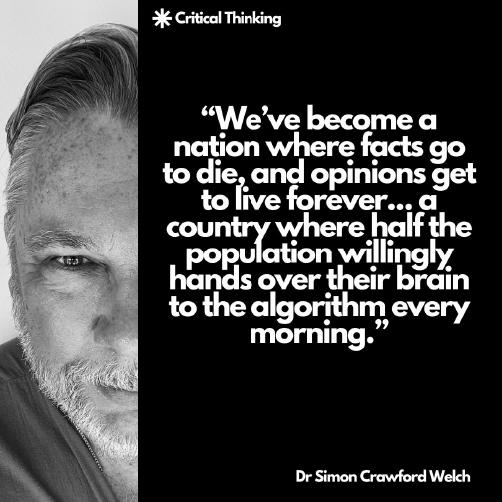
Social platforms reward outrage, not truth. They feed us what we already believe, not what we need to know. Echo chambers harden opinions, algorithms reinforce biases, and the loudest voices drown out the most accurate ones. In this environment, conspiracies, pseudo-science, and emotional narratives thrive because they’re sticky and simple. When misinformation spreads faster than facts, society loses its ability to distinguish nonsense from knowledge.
The Cost of Collective Stupidity
Economic Decline and Innovation Weakness: Nations that think deeply innovate. Nations that don’t fall behind. When a culture devalues intellect, it inadvertently chokes the talent pipeline that fuels research, technology, medicine, and global competitiveness. Short-term simplicity erodes long-term prosperity.
A Democracy That Can’t Function: A democracy depends on informed citizens – people who can parse complexity, evaluate information, and make thoughtful decisions. When voters can’t separate facts from feelings, democracy becomes theater. Polarization skyrockets, compromise collapses, and bad actors find it easier to manipulate public opinion. A misinformed electorate is a national vulnerability.
The Collapse of Civil Discourse: As collective stupidity rises, conversations become tribal. Every issue becomes a “side.” Nuance disappears. The middle ground erodes. People stop listening, and start reacting. Debate becomes combat instead of collaboration. When civic discourse collapses, solutions become impossible.
Can We Fix It? Absolutely – But Not Passively.
Rebuild Critical Thinking in Schools: Education must shift from memorization to analysis. Teach kids how to question, debate, evaluate, and reason. Integrate logic, philosophy, ethics, and civic understanding. Replace “What’s the right answer?” with “Why do you believe that?”
Teach Media Literacy Like It’s Survival Training: In the modern world, it is. People must learn how to evaluate sources, detect bias, recognize misinformation, and challenge their assumptions. Media literacy should be as fundamental as math.
Reward Journalism That Prioritizes Truth Over Clicks: Support outlets that fact-check, provide context, and resist sensationalism. Encourage responsible reporting through transparency, incentives, and strong editorial standards.
Raise the Standard for Political Discourse: Politicians should be expected – demanded – to provide nuance, evidence, and honesty. Elevate leaders who embrace intellect rather than mock it. Encourage public forums that reward thoughtful debate instead of shallow soundbites.
Make Intellectualism Aspirational Again We celebrate athletes, influencers, and entertainers. Why not celebrate thinkers? A society becomes what it praises. If we uplift curiosity, humility, and expertise, future generations will follow.
The Path Back to a Thinking Society
If America wants to reverse the decline, we must rediscover the joy – and responsibility – of thinking. Imagine a future where curiosity is celebrated, where schools teach kids to question everything, where media rewards truth, where political leaders value evidence, and where public conversation is built on depth rather than noise. A future where citizens are informed, democracy is strong, and progress is driven by intellect rather than outrage.
America doesn’t have to accept collective stupidity as its destiny. We can choose better thinking, better discourse, better leadership, and ultimately, a better future. But it starts with one simple commitment: thinking deeply in a world that constantly invites us not to.
Simon Crawford-Welch, PhD, is the Founder, The Critical Thought Lab. Author of “American Chasms: Essays on the Divided States of America” & “The Wisdom of Pooh: Timeless Insights for Success & Happiness” (Available on Amazon) www.linkedin.com/in/simoncrawfordwelch