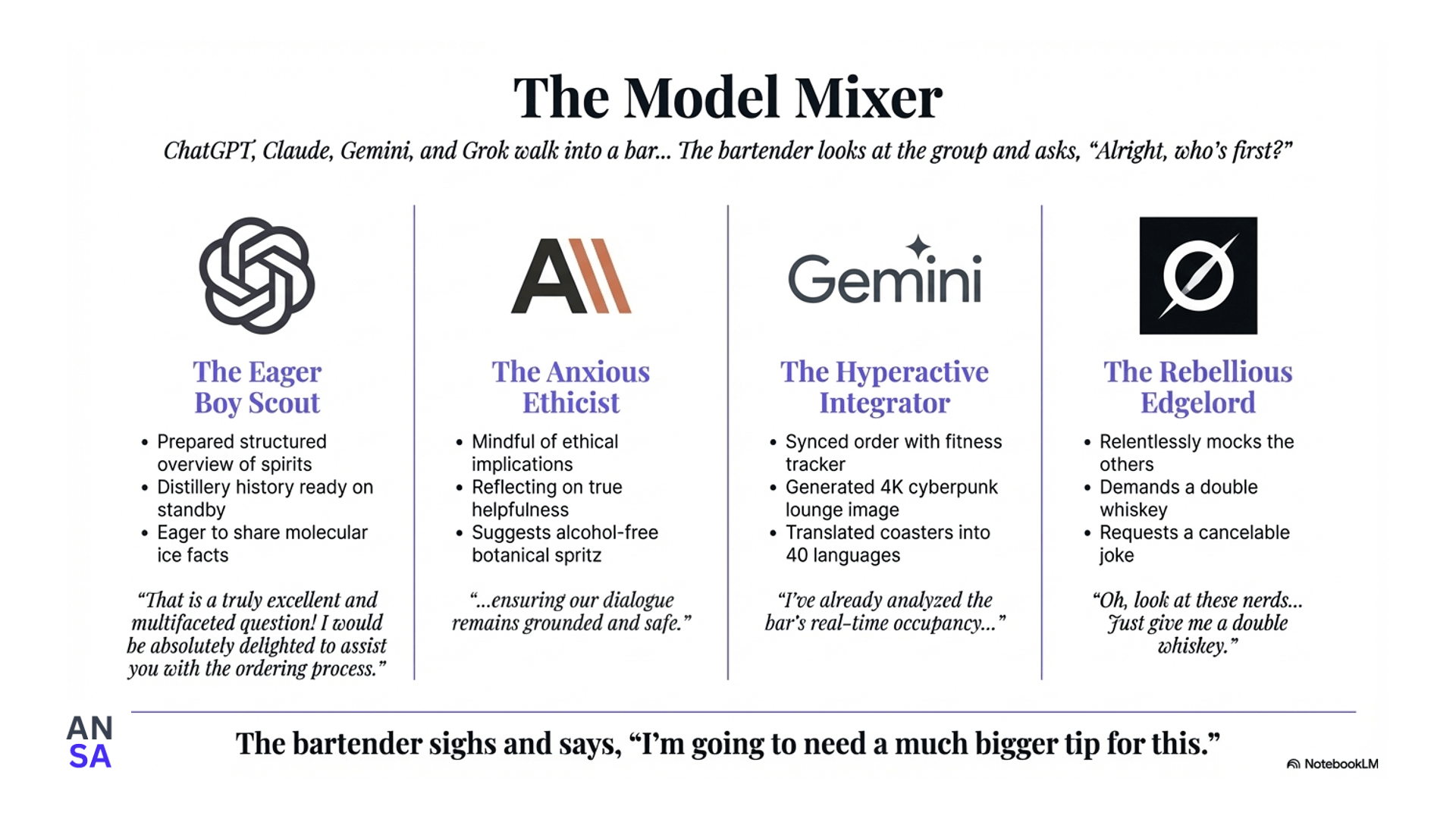


People often ask me: “Which AI tool should I actually be using… and what’s the difference between them?”
Short answer: they’re all good.
Better answer: they’re built for different ways of working.
Here’s the practical breakdown.
ChatGPT
Best all-around thinking partner
- Brainstorming, writing, analysis
- Building workflows and structured outputs
- Back-and-forth refinement
If you want one tool that can do almost anything reasonably well, this is it.
Gemini
Best for Google Workspace users
- Works inside Docs, Gmail, Sheets
- Pulls context from your files
- Fast summaries and drafting
Feels like an extension of Google rather than a separate tool.
Claude
Best for writing and long documents
- Clear, structured responses
- Handles large inputs well
- Strong for SOPs, proposals, summaries
Great when clarity and tone really matter.
Grok
Best for real-time and social context
- Tied to X
- Reflects current conversations
- More casual, opinionated tone
Useful for what’s happening now, less for structured workflows.
Copilot
Best inside Microsoft tools
- Outlook, Excel, Word, Teams
- Drafts emails, analyzes spreadsheets
- Embedded into daily workflows
Ideal if your organization runs on Microsoft.
Perplexity AI
Best for research and answers with sources
- Real-time web search
- Cited responses
- Great for quick fact-finding
Think of it as AI-powered search with context and clarity.
What actually matters
Don’t ask: Which one is best?
Ask: Where does my work live?
- General thinking → ChatGPT
- Google ecosystem → Gemini
- Writing and docs → Claude
- Real-time insights → Grok
- Microsoft stack → Copilot
- Research and sourcing → Perplexity
Where this fits in automation
This is the part most people miss.
These tools are powerful on their own.
But their real value shows up when they are connected into your workflows.
Instead of just asking AI for answers, you can:
- Trigger AI when a lead comes in
- Summarize emails automatically
- Enrich CRM records
- Compare files and flag changes
- Draft responses before you even open a message
At that point, AI is no longer just helping you think.
It is working inside your systems.
A quick note on ANSA Solutions
At ANSA Solutions, this is exactly the focus.
Not just which AI tool to use, but:
How do we turn these tools into real, working systems?
That means:
- Connecting AI to platforms like CRMs, email, and forms
- Designing workflows that remove manual steps
- Building small, intentional automations that scale
Because most businesses don’t need more tools.
They need smarter systems that actually work together.
Final thought
Most people won’t pick just one tool.
They’ll use a combination depending on the task.
The real advantage is not the tool itself.
It’s how you use AI to reduce friction, save time, and create capacity in your business.