


By Simon Crawford Welch, Ph.D.
There is something unsettling about modern leadership, and it is difficult to name at first. On the surface, everything appears to be improving. Leaders are more articulate, more self-aware, more attuned to the language of empathy and inclusion. Organizations invest heavily in leadership development, communication training, and cultural alignment. There is no shortage of frameworks, playbooks, or well-produced content explaining how leadership should look.
And yet, something feels off.
For all the polish, leadership today often feels hesitant. Decisions take longer. Messages feel carefully constructed, but strangely hollow. There is a sense that leaders are speaking often, but saying less. The question is not whether leadership exists, it clearly does. The question is whether it has been diluted, softened, or constrained into something that looks right on the surface but lacks substance underneath.
The Rise of Performative Leadership
Leadership has always had an element of performance. Communication matters. Presence matters. The ability to inspire, align, and influence others has never been purely mechanical. But something has shifted in recent years. The balance between substance and signaling has tilted.
Leaders today are increasingly optimizing for how their decisions are perceived rather than whether those decisions are correct. They are managing audiences as much as they are managing organizations. Every statement is filtered through layers of potential interpretation. Every decision is evaluated not only on its outcome, but on how it might be received across internal teams, external stakeholders, and the broader digital ecosystem.
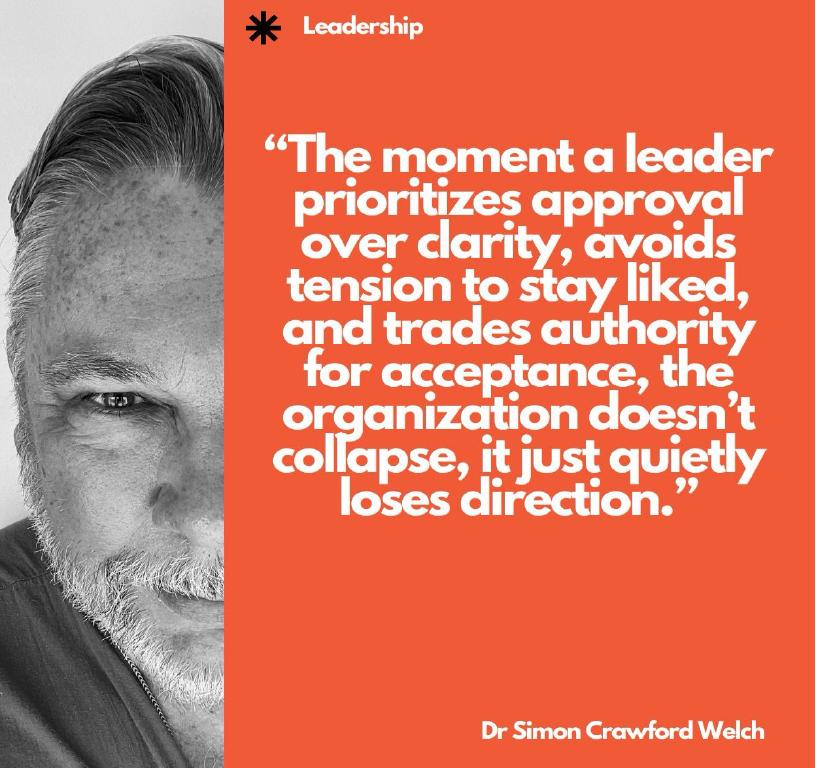
This creates a subtle but profound distortion. Leadership becomes less about conviction and more about calibration. The goal is no longer to move the organization decisively forward, but to do so without triggering backlash. Over time, this erodes clarity. When every message is softened, every stance hedged, and every decision framed to minimize friction, something essential is lost.
When leadership becomes a performance, truth becomes negotiable.
The Constraint Problem
It would be easy to frame this as a cultural issue alone, but the reality is more structural. Leaders today operate within an unprecedented web of constraints. Legal considerations shape decisions before they are even articulated. Human resources frameworks introduce necessary protections, but also layers of caution. Brand considerations extend into every communication. Social media ensures that missteps are not only visible, but amplified.
None of these constraints are inherently problematic. In many cases, they are necessary and overdue. The issue arises when they accumulate.
Constraint, in isolation, sharpens judgment. Constraint, in excess, paralyzes it.
Leaders begin to hesitate not because they lack intelligence or intent, but because the margin for error feels vanishingly small. The cost of being wrong, or even being perceived as wrong, outweighs the perceived benefit of being decisive. In this environment, inaction begins to masquerade as prudence. Delayed decisions are reframed as thoughtful deliberation. Safe choices are presented as strategic alignment.
The result is not better leadership. It is safer mediocrity.
The Quiet Disappearance of Moral Courage
At its core, leadership has always required a degree of moral courage. Not the dramatic, headline-grabbing kind, but the quieter, more consistent willingness to take a stand when it would be easier not to. To make decisions that will not be universally popular. To accept personal risk in service of organizational clarity.
Historically, this meant leaders occasionally stood alone. They made calls without complete consensus. They absorbed criticism as a consequence of action, not as a signal to retreat.
Today, that posture has become increasingly rare.
Decisions are often socialized to the point of dilution. Language is engineered to remove sharp edges. Consensus becomes both the process and the justification. It feels collaborative, even progressive. But it can also become a mechanism for avoiding responsibility. When everyone owns the decision, no one truly carries it.
Courage has not disappeared, but it has been replaced, in many cases, with calibration…. And calibration, while useful, is not a substitute for conviction.
From Authority to Appeasement
To be fair, leadership needed to evolve. The era of unchecked authority, where decisions were made unilaterally and enforced without regard for impact, created its own set of failures. Organizations paid the price through disengagement, toxicity, and a lack of psychological safety. The shift toward empathy, listening, and inclusion was not only necessary, it was inevitable.
But in correcting for those excesses, there is a growing sense that the pendulum has swung too far.
Authority has become a loaded concept. Leaders are increasingly cautious about asserting it, for fear of being perceived as rigid or out of touch. Boundaries blur. Expectations soften. Accountability becomes inconsistent, not because leaders do not value it, but because enforcing it carries relational risk.
In this environment, leadership can begin to resemble appeasement. Difficult conversations are deferred. Standards are adjusted rather than upheld. Decisions are shaped by the desire to maintain harmony rather than drive outcomes.
When everything is negotiated, nothing is led.
The Cost of Drift
The consequences of this shift are not always immediate, which makes them easy to overlook. Organizations rarely collapse because leadership has become overly cautious. Instead, they drift.
Strategy becomes less distinct. Priorities shift subtly, then frequently. Teams operate with partial clarity, filling in gaps with their own interpretations. High performers, who tend to thrive in environments of clarity and direction, begin to disengage. Not loudly, but gradually.
Execution slows. Momentum fades. The organization remains busy, but less effective.
Drift is dangerous precisely because it is difficult to detect. There is no single moment where leadership fails. There is only a gradual erosion of clarity, conviction, and direction.
Reclaiming Leadership Without Regressing
The solution is not to return to a more authoritarian model of leadership. That path has already proven its limitations. The challenge is more nuanced. It is about reclaiming the core elements of leadership that have been diluted, without abandoning the progress that has been made.
This requires leaders to become comfortable with a certain level of tension. Clear decision rights must be re-established, even when it feels uncomfortable. Leaders must be willing to take calculated risks, understanding that not every decision will be universally supported. Communication must become more direct, not less empathetic, but less diluted. Ownership of outcomes must be visible and explicit.
At the same time, emotional intelligence, awareness of impact, and respect for people cannot be discarded. These are not constraints to be removed, but capabilities to be integrated. The future of leadership is not softer or harder. It is more grounded. It is leadership that can hold conviction and empathy simultaneously. That can listen deeply, but still decide decisively. That can absorb criticism without being governed by it.
The Question We Avoid
So, have leaders lost their way? Or have they adapted too well to a system that rewards safety over substance?
That is the more uncomfortable question. Because it suggests that the issue is not simply individual leaders falling short, but a broader environment that subtly incentivizes caution, performance, and risk avoidance. And if that is true, then the path forward is not just about changing how leaders behave. It is about challenging what leadership is being rewarded for.
At some point, every leader faces a choice. To perform leadership, or to carry it. The difference is not always visible in the moment. But over time, it becomes impossible to ignore.
Simon Crawford-Welch, PhD, is the Founder of The Scale Up Company (www.thescaleupcompany.com), which helps businesses turn ambition into disciplined, scalable execution so growth stops being chaotic and starts becoming intentional. His latest book, ‘Artificial Authority: When Leadership Is Performed Instead of Carried’, is available on Amazon. (https://a.co/d/082sCqm4)