


By Simon Crawford Welch, PhD.
We live in what should be the greatest age of informed thinking in human history. Almost anything we want to know is available within seconds. We carry access to more information in our pockets than presidents, scientists, CEOs, or scholars could have imagined a generation ago. Yet I am increasingly convinced that access to more information is not necessarily making us better informed. In some cases, it may be doing exactly the opposite.
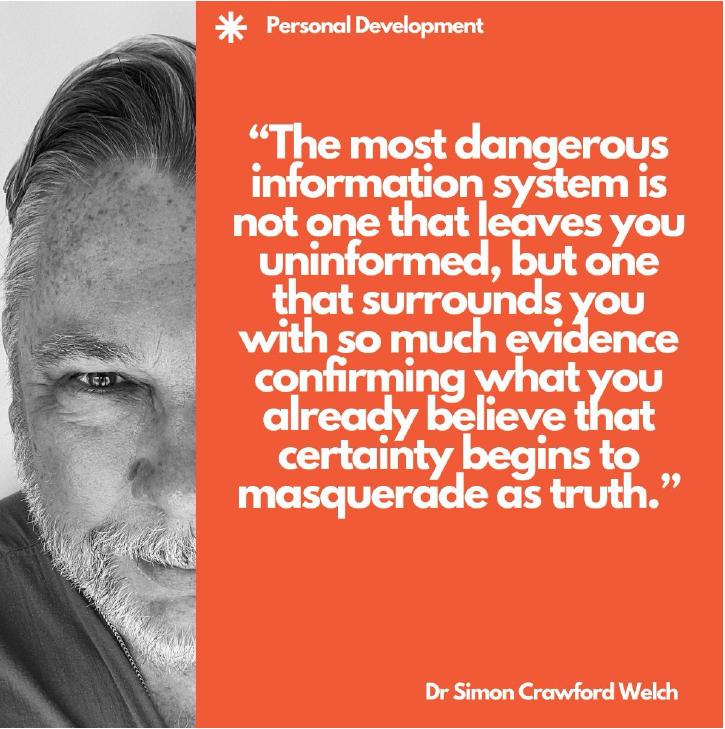
The problem is not simply misinformation, although there is plenty of that. The deeper problem is what I think of as closed loop thinking: an information environment in which what we already believe increasingly determines what information reaches us, and that information then reinforces what we already believe. The loop tightens gradually. We feel more informed because we are consuming more information, while becoming less exposed to anything capable of changing our minds.
That matters socially. It matters politically. But I suspect its most underestimated consequence may be in business, where enormous decisions are increasingly being made by intelligent people surrounded by sophisticated information systems that continuously confirm their own assumptions.
More Information, Narrower Worlds
The scale of the change in how we consume information is remarkable. Pew Research Center reports that 86% of American adults now get news from digital devices at least sometimes, while 53% get news from social media. Globally, the Reuters Institute’s 2026 Digital News Report found that 54% of people across 48 markets use social media and video networks for news, now ahead of news organizations’ own websites and apps. Thirty percent describe those social and video platforms as their main source of news.
Perhaps the more revealing number comes from Pew’s research into how people encounter news. Forty nine percent of Americans now say they mostly get news because they happen to come across it rather than because they actively seek it out. In 2019, that figure was 39%. Among adults under 30, 73% say they mostly come across news rather than deliberately looking for it.
Think about what that means. Increasingly, we are not choosing what information to examine. Information is choosing us, based at least partly on what we previously clicked, watched, liked, shared, searched for, argued with, or lingered over.
There is nothing sinister about the commercial logic behind this. Platforms want relevance and engagement. If I consistently watch videos about motorcycles, showing me more motorcycles is probably good product design. The difficulty begins when essentially the same machinery mediates politics, economics, science, culture, business, and our understanding of other people.
A system designed to predict what will interest me is not necessarily a system designed to challenge me.
How the Loop Closes
Algorithms are only part of this. Blaming technology entirely would let human beings off rather cheaply.
We have always suffered from confirmation bias. We notice evidence that supports our beliefs more readily than evidence that threatens them. We prefer people who broadly see the world as we do. We interpret ambiguous information through the lens of assumptions we already hold. Social media did not invent those tendencies. It industrialized their reinforcement.
The research is more nuanced than the popular claim that algorithms simply create political polarization. A major series of studies involving Facebook and Instagram found that algorithmic feeds did expose people disproportionately to politically like minded content, yet changing the feed to reduce that exposure did not necessarily reduce polarization. Human beliefs, identity, social groups, media choices, and political loyalties are considerably more complicated than an algorithm alone.
That nuance actually makes closed loop thinking more interesting. The loop is not technological. It is psychological, social, and increasingly organizational. Technology simply makes it extraordinarily efficient.
The result can be strange. Two intelligent people can consume large quantities of information about the same subject and emerge not merely with different opinions, but with different versions of reality. They trust different experts, encounter different evidence, see different events emphasized, and regard the other person’s sources as inherently suspect. We are no longer always arguing about what the facts mean. Sometimes we are arguing about which facts are allowed into the room.
Business Has Its Own Algorithms
Politics is the obvious place to see this happening, but business may be where closed loop thinking becomes most expensive.
I have sat through enough executive discussions to know that organizations create their own information bubbles remarkably easily. They do not require Facebook or TikTok to do it. Culture can become an algorithm. Reporting structures can become algorithms. Incentive plans, dashboards, budgets, consultants, and leadership behavior all influence which information rises through an organization and which quietly disappears.
Imagine a CEO who becomes convinced that a particular strategy is working. The questions being asked begin from that assumption. Management prepares reports explaining the strategy’s progress. KPIs are constructed around its execution. Meetings focus on how to improve it. People whose careers depend upon its success become responsible for reporting whether it is succeeding.
Eventually, the organization can possess an astonishing amount of data and still know surprisingly little.
Daniel Kahneman, Dan Lovallo, and Olivier Sibony made this point years ago when examining strategic decision making. Confirmation bias can cause teams to discount information that contradicts a preferred recommendation, while executives who understand intellectually that biases exist often remain surprisingly poor at correcting for them in practice.
This is where I think we make a dangerous mistake about data. We tend to assume that more data produces better decisions. It certainly can. But data collected inside a closed loop may simply give a bad assumption greater statistical dignity.
If the original premise is wrong, gathering more evidence selected through that premise does not necessarily move us closer to the truth. Sometimes it simply makes us more confident.
When Confidence Rises Faster Than Decision Quality
Closed loop organizations tend to develop several recognizable symptoms. Weak signals are dismissed because they do not fit the prevailing narrative. Dissent starts to look obstructive rather than useful. Managers learn which answers travel well upward. Metrics gradually measure execution of the strategy rather than validity of the strategy itself.
Eventually the organization becomes very good at answering questions nobody has stepped back to examine.
This is particularly dangerous for successful companies. Failure tends to challenge assumptions rather brutally. Success can protect them. If the business has grown for several years, if the founder has repeatedly been right, or if the existing model has produced substantial profits, questioning the underlying assumptions can begin to feel almost disrespectful.
Success provides evidence. Unfortunately, it can also provide immunity from scrutiny.
That is how intelligent executives can make poor decisions without anybody in the room being stupid, dishonest, or incompetent. Everyone may be reasoning perfectly well from information produced within the same intellectual ecosystem.
AI Can Close the Loop Even Faster
Artificial intelligence introduces another fascinating dimension to this.
I am enormously optimistic about AI, but I worry about how easily it can become a confirmation machine. An executive can ask an AI system why a strategy makes sense, request research supporting it, generate financial scenarios around it, anticipate objections, prepare rebuttals, and produce a beautifully reasoned presentation explaining the recommendation.
The output may be extremely sophisticated. The original assumption may still be wrong.
AI does not eliminate the need for independent thinking. It increases the importance of asking questions capable of disproving us. I find prompts such as, “What evidence would demonstrate that this assumption is wrong?” or “Make the strongest case against my recommendation” far more interesting than simply asking an AI system to strengthen an argument I already believe.
Used properly, AI could become one of the greatest tools we have ever created for breaking closed loops. Used lazily, it may allow us to manufacture better arguments for whatever we wanted to believe in the first place.
Building an Open Loop
The answer is not to distrust information or celebrate contrarianism for its own sake. There is nothing particularly intelligent about disagreeing with everyone. The goal is to create information systems that remain capable of surprising us.
Healthy organizations deliberately introduce friction into important decisions. They search for disconfirming evidence. They separate advocacy from evaluation. They listen carefully to anomalous customer behavior. They create space for people to challenge assumptions without turning every disagreement into a test of loyalty. Most importantly, they periodically examine whether the question itself is still the right question.
There is a simple test I increasingly like: “Is our information system helping us discover whether we are right, or helping us prove that we are right?”
Those are very different activities.
For most of history, human beings struggled because information was scarce. Our emerging problem may be stranger. We can now have virtually unlimited information while encountering remarkably little that seriously challenges us.
Perhaps intellectual independence in the modern world will require a conscious willingness to introduce discomfort into our own information diets. Read people you disagree with. Ask what would change your mind. Invite the person in the meeting who sees the problem differently. Look for the number that does not fit the story.
Because if everything you consume confirms what you already believe, you may indeed be becoming more informed. But there is another possibility worth considering…… you may simply be becoming more certain.
Simon Crawford-Welch, PhD, is the Founder of The Scale Up Company (www.thescaleupcompany.com), which helps businesses turn ambition into disciplined, scalable execution so growth stops being chaotic and starts becoming intentional. His latest book, ‘Artificial Authority: When Leadership Is Performed Instead of Carried’, is available on Amazon. (https://a.co/d/082sCqm4)