


By Simon Crawford Welch, Ph.D.
Businesses have never known more about their customers. We survey them, track satisfaction, analyze comments, monitor reviews, study customer journeys and increasingly use artificial intelligence to identify patterns in thousands of responses almost instantly. We can see what customers like, what frustrates them, where expectations are falling short and, in some cases, why they leave.
The harder question is whether organizations are actually changing behavior because of what those customers are saying.
I have sat through enough executive meetings over the years to recognize the pattern. Someone presents the latest customer feedback. The data is interesting. The comments are occasionally uncomfortable. Everyone agrees something needs to improve. Actions are discussed, managers are asked to follow up, and the organization moves on. A quarter later, another report appears, often containing many of the same observations.
The problem is not the quality of the customer intelligence. The problem is the distance between discovering something and changing the human behavior that created it.
That gap is what makes the alliance between CustomerCount, CustomerView and PitchEQ so compelling. Each plays a distinct role. CustomerCount captures what customers are telling you. CustomerView helps explain what it means. PitchEQ turns that intelligence into the behaviors that improve what happens next.
 We Have Become Very Good at Listening
CustomerCount helps organizations capture the authentic voice of their customers and employees. That matters because there is often a meaningful difference between what an organization believes it is delivering and what the customer actually experiences.
Companies naturally develop internal narratives about themselves. Sales leaders believe their teams are consultative. Service departments believe they are responsive. Executives believe their brands stand for certain things. Employees become familiar with internal processes and stop noticing friction that is painfully obvious to someone encountering the organization for the first time.
Customers are refreshingly indifferent to those internal narratives. They simply tell you what happened.
CustomerCount captures those experiences. CustomerView then helps organizations interpret the resulting intelligence, identify patterns, understand underlying drivers and see the broader customer experience more clearly. Individual comments become themes. Themes become insight. What might otherwise be dismissed as an isolated complaint can reveal something systemic.
That intelligence is enormously valuable, but it also creates an obligation. Once you know where customers are struggling, where trust is deteriorating or where employees are consistently missing the moment, what happens next?
Reporting the problem is not the same as resolving it.
The Difficult Space Between Knowing and Doing
There is a persistent assumption in business that once people know what they should do differently, they will somehow begin doing it. Anyone who has managed people for any length of time knows how unreliable that assumption can be.
Telling a salesperson to listen more does not make them a better listener. Telling someone to show more empathy does not suddenly make them more empathetic when an angry customer is on the telephone. Explaining that customers dislike feeling pressured does not automatically give someone the judgment to recognize the precise moment when a conversation has begun to feel that way.
There is a difference between knowledge and capability, and there is an even larger difference between capability in a classroom and capability when the conversation becomes consequential.
Real customers hesitate, contradict themselves, become defensive and change their minds. People say price is the problem when price may simply be the easiest objection to express. Two decision makers can enter the same conversation with completely different motivations. Human conversations are dynamic, and the employee has to notice what is changing, interpret what it means and decide what to do next.
That is where PitchEQ changes the equation.
The Difference Is the Behavioral Engine
There are already plenty of AI systems capable of creating conversational avatars. A large language model can produce a fictional customer, generate objections and carry on a reasonably convincing conversation.
But an avatar is not the same thing as a behavioral model.
PitchEQ is an AI-powered behavioral simulation platform that uses proprietary modeling algorithms to recreate how real people respond, adapt and make decisions in consequential business conversations. That distinction matters because the conversational AI is only the visible layer. The real differentiation sits underneath it, in the behavioral engine that governs how the simulated customer reacts and evolves as the interaction develops.
Those proprietary behavioral modeling algorithms have been developed from decades of research, observation and practical experience in real business environments. They are designed around the forces that actually shape human decision making: how trust develops, how resistance appears, how interest rises or falls, how emotional states shift, how confidence deteriorates, how personalities respond to pressure and how multiple decision makers influence one another.
That is a fundamentally different proposition from programming an AI agent with a handful of objections.
Real customers are not static personas. Their behavior changes in response to the conversation itself. A customer who feels heard may become more open. A customer who senses pressure may retreat. Someone who starts with a price objection may reveal that the real concern is trust. Two people making the same purchase may be motivated by entirely different things.
PitchEQ is designed to model those movements.
That matters because the purpose of practice is not simply to teach someone what to say next. It is to develop judgment. The user must learn to recognize what is happening beneath the words, understand why the conversation is moving in a particular direction and adapt accordingly.
AI provides the conversational flexibility. The proprietary behavioral modeling provides the realism, the consequence and, ultimately, the learning value.
When Customer Intelligence Becomes Practice
The alliance becomes considerably more powerful when those behavioral models are informed by authentic customer intelligence.
Imagine CustomerCount identifies a recurring pattern in which customers say a company’s salespeople are knowledgeable and professional but make them feel rushed once pricing is introduced. CustomerView helps the organization understand where that pattern is appearing, what may be driving it and how significant it is.
Traditionally, that finding might then be shared with the sales team and incorporated into training. Now imagine that same intelligence becoming an input into PitchEQ.
The simulated customer begins engaged and interested. Pricing is introduced and their emotional posture changes. Answers become shorter. Hesitation appears. An objection surfaces. The employee has to determine what is really happening.
If the employee pushes harder, the simulated customer may retreat further. If the employee discounts prematurely, the interaction may evolve differently than if they slow down, ask another question and uncover the underlying concern.
The employee is no longer simply rehearsing a script. They are experiencing the consequences of their own behavior inside a dynamic interaction.
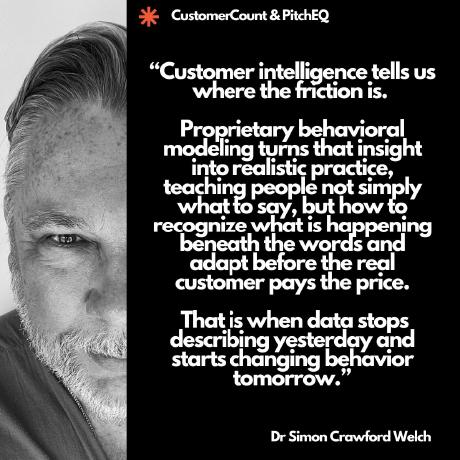
That is where the three products become more powerful together than independently. CustomerCount captures what customers are experiencing. CustomerView interprets what those experiences mean. PitchEQ converts that intelligence into realistic behavioral practice.
Customer feedback moves from reporting into rehearsal.
From Feedback Report to Feedback Loop
This is the real strategic logic behind the alliance.
CustomerCount captures authentic Voice of the Customer data. CustomerView provides the analytical layer that helps organizations understand that data in context. PitchEQ then turns those insights into realistic simulations that allow employees to practice the behaviors most likely to influence what customers experience next.
Those employees return to real customer interactions, and the organization listens again. Did the experience improve? Did the complaint decline? Did satisfaction increase? Did conversion improve? Did customers notice the difference?
That creates something much more valuable than another technology integration. It creates the potential for a closed-loop learning system in which customer experience informs human development, human development influences behavior, and behavior creates the next generation of customer experience.
Bob Kobek, President and CEO of CustomerCount and CustomerView, describes it this way: “PitchEQ is the perfect example of how data talks to create real customer insight. Its seamless integration with our EFM systems interprets authentic voice-of-the-customer data and produces value intended to increase revenue.”
I particularly like the idea of data beginning to “talk.” Historically, customer data has been very good at describing what happened yesterday. The opportunity now is to use that same intelligence to influence what happens tomorrow.
For me, what makes this alliance so compelling is that it connects three things businesses have historically kept separate: authentic customer intelligence, behavioral science and human performance. CustomerCount captures what customers are telling us. CustomerView helps us understand what it means. PitchEQ then applies proprietary behavioral modeling algorithms built from decades of research and real-world business practice to create simulations that do more than talk. They behave, react and change as the conversation changes. I am not aware of anything else in the market that brings those elements together in quite this way. It is a genuinely holistic approach, from listening to understanding, from understanding to behavioral practice, and ultimately from practice to measurable performance.”
Measurement Is Not Improvement
Modern business has developed an understandable affection for measurement. Dashboards, scores and analytics are useful. They create accountability and make problems easier to see.
But measurement alone does not improve a customer experience. Eventually somebody has to behave differently.
The customer experience industry has spent decades becoming better at listening. The next competitive advantage may belong to organizations that create the shortest possible path between what the customer says and what the employee does differently as a result. That is why the combination of CustomerCount, CustomerView and PitchEQ has such potential. It connects authentic customer intelligence with interpretation, proprietary behavioral science, realistic simulation, human development and measurable business outcomes in a continuous loop.
For years, organizations have asked customers some version of the same question: tell us how we did. The real value of the answer was never simply knowing what customers thought. It was using what they told us to improve what happens next.
Simon Crawford Welch, PhD, is CEO & Co-Creator of PitchEQ, an AI-powered simulation platform that uses proprietary scientific behavioral modeling algorithms to recreate realistic customer behaviors and improve performance in consequential business conversations. Learn more at pitcheq.com. His latest book, ‘Artificial Authority: When Leadership Is Performed Instead of Carried’, is available on Amazon.